
The SEO Framework Chandler, AZ Businesses Need
SEO success for local businesses in Chandler, AZ does not come from one tactic. It comes from a connected framework that helps Google, Google Maps, AI search tools, and customers clearly understand what your business does, where you serve, and why you should be trusted.
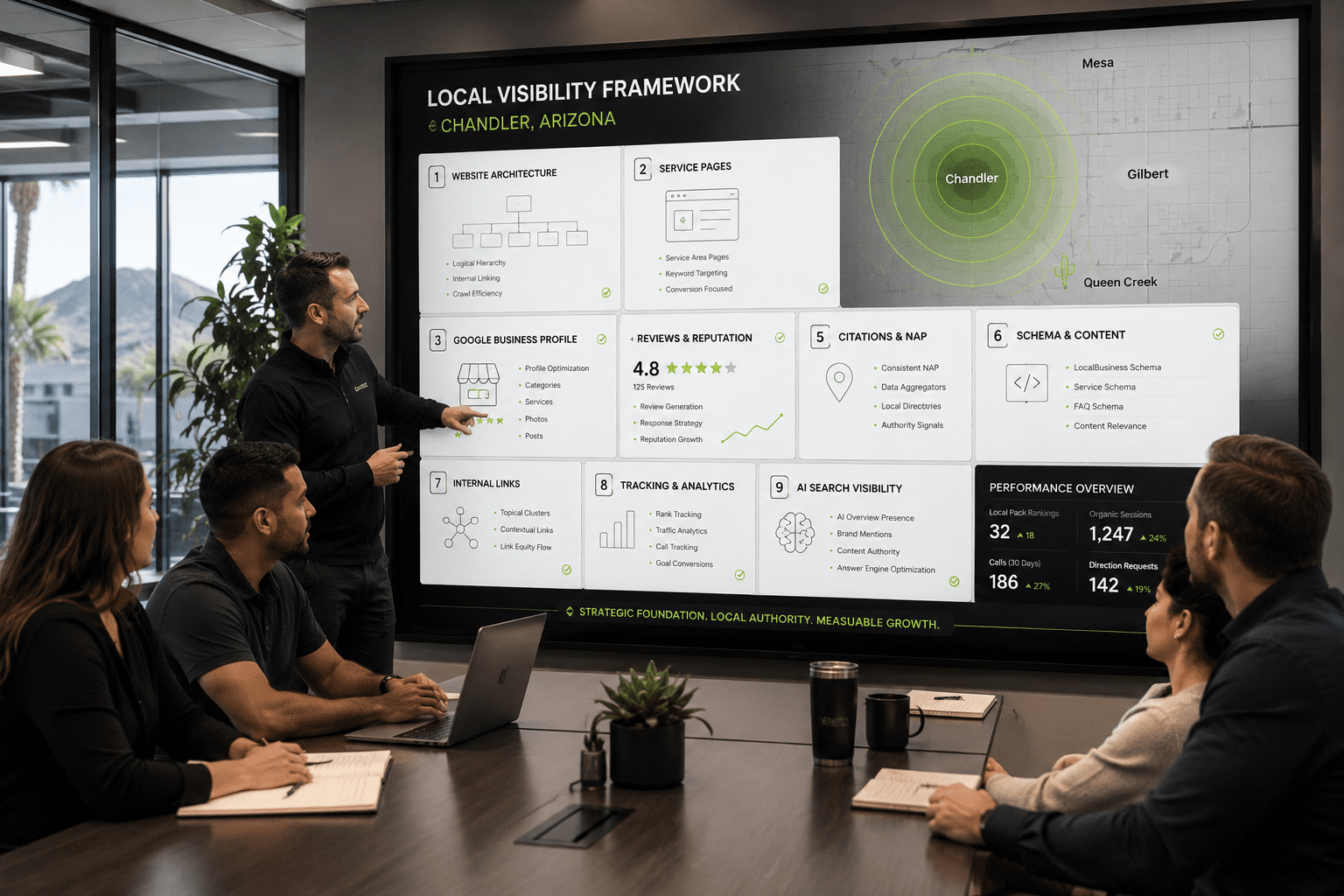
Most local businesses do not have an SEO problem because they are bad businesses. They have a visibility problem because their digital signals are incomplete, scattered, or unclear. A company may have great service, loyal customers, skilled employees, and years of experience, but still struggle to show up when someone searches in Chandler, Google Maps, or an AI search tool.
That is why local SEO in Chandler, AZ needs to be treated as a framework, not a checklist of random tasks. A blog post here, a few directory listings there, and a handful of keywords on a homepage are not enough in a competitive market. Search engines and customers need a clearer picture.
The strongest SEO framework for a Chandler business connects your website, Google Business Profile, service pages, location coverage, reviews, citations, schema, internal links, and tracking into one visibility foundation. When those pieces support each other, your business becomes easier to find, easier to understand, easier to trust, and easier to recommend.
The goal is not to chase rankings for the sake of rankings. The goal is to build the local business signals that help the right customers find you when they are ready to call, book, visit, or compare options.
Why A Framework Matters More Than Random SEO Tasks
Many Chandler businesses have tried some version of SEO before. Maybe an agency added keywords to the homepage. Maybe someone created a few blog posts. Maybe the Google Business Profile was claimed but not fully built out. Maybe directory listings were submitted years ago and never checked again.
The problem is not that those tasks are useless. The problem is that disconnected tasks rarely create a strong local visibility foundation. Google and AI systems are trying to understand entities, services, locations, reviews, reputation, content, and consistency. Customers are doing something similar, just faster. They compare businesses based on what they can see and understand in the moment.
A framework gives every visibility asset a role. Your website explains the business. Your service pages clarify what you do. Your location pages or service-area content clarify where you do it. Your Google Business Profile confirms business details. Your reviews prove customer experience. Your citations support consistency. Your schema helps search engines classify your information. Your tracking shows what is actually producing opportunities.
Core Element 1: Website Architecture
Website architecture is one of the most overlooked parts of local SEO. A local business website should not be a digital brochure with a homepage, about page, contact page, and one generic services page. That structure may look simple, but it often gives search engines too little information.
For a Chandler business, good website architecture should answer basic questions clearly: What services do you offer? Which services matter most? Where do you provide them? Who do you help? What proof do you have? What should someone do next?
A better local website structure usually includes:
- A homepage that clearly explains the business, market, and value proposition.
- Dedicated service pages for each important revenue-driving service.
- Location or service-area pages where market coverage needs to be clarified.
- FAQ sections that answer real buyer questions.
- Internal links that connect related services, markets, and resources.
- Conversion paths for calls, forms, scheduling, or quote requests.
The goal is not to create more pages just to have more pages. The goal is to create useful pages that make your business easier to understand.
Core Element 2: Service Pages
Service pages are where many local businesses either win or lose search relevance. If your business offers several services, each major service should have its own page. A homepage cannot explain everything with enough depth.
For example, an HVAC company in Chandler may need separate pages for AC repair, AC replacement, heating repair, maintenance plans, indoor air quality, and emergency HVAC service. A law firm may need separate pages for estate planning, probate, business law, and real estate matters. A dental office may need pages for cleanings, implants, cosmetic dentistry, Invisalign, and emergency dentistry.
A strong service page should explain the service in plain language, describe when a customer needs it, address common objections, include trust signals, answer practical questions, and guide the visitor toward action. It should also connect naturally to related services and relevant location pages.
Core Element 3: Google Business Profile Signals
For local businesses, the Google Business Profile is often just as important as the website. It is what many customers see before they click anywhere. It influences how your business appears in Google Maps, local search results, and the map pack.
Your profile should be accurate, complete, and aligned with your website. The business name, category, phone number, address or service-area setup, hours, photos, services, and website link should all support the same story. If the profile says one thing and the website says another, the signals become weaker.
Category selection matters. Service details matter. Photos matter. Review responses matter. Regular updates matter when they are useful. A neglected profile can make a good business look inactive. A clear, active profile can help customers feel like they are dealing with a real operator.
Core Element 4: Reviews And Reputation
Reviews are not just social proof. They are local trust signals. A potential customer looking for a Chandler contractor, dentist, attorney, med spa, or consultant is likely to compare ratings, review count, review content, recency, and owner responses before making contact.
A good review strategy should be consistent and ethical. Ask real customers for honest feedback. Make the review process simple. Respond to reviews professionally. Do not buy reviews, fake reviews, or pressure customers to include unnatural keywords.
Review content can also help customers understand the types of problems your business solves. A review that mentions responsiveness, professionalism, a specific service, or a local experience can be more persuasive than a generic five-star rating with no detail.
Core Element 5: Citations And Directory Consistency
Citations are mentions of your business information across directories, local platforms, navigation systems, industry sites, and business data sources. They often include your business name, address, phone number, website, hours, and categories.
For Chandler businesses, citation consistency helps reduce confusion. If different platforms show different phone numbers, old addresses, outdated hours, or inconsistent categories, search engines and customers may receive mixed signals.
The goal is not to chase every directory on the internet. The goal is to make sure the important ones are accurate, consistent, and aligned with your real business. This is especially important if your company has moved, rebranded, changed phone numbers, added locations, or expanded service areas.
Core Element 6: Schema Markup
Schema markup helps search engines interpret the information on your website. It does not replace helpful content, but it can clarify your business details, services, location information, FAQs, and page structure.
For local visibility, common schema opportunities include LocalBusiness schema, Service schema, FAQ schema, Breadcrumb schema, and Article schema where appropriate. The markup should match the visible page content. It should not make claims that are not supported on the page.
Schema is especially useful when your website has a strong structure. When service pages, location pages, FAQs, internal links, and business information are already clear, schema helps reinforce the meaning.
Core Element 7: Internal Linking
Internal links help both visitors and search engines move through your website. They show relationships between services, locations, resources, and next steps. A service page might link to related services, a Google Business Profile guide, a location page, and a relevant FAQ. A blog post might point readers to a checklist, a deeper service page, or a strategy session.
Without internal links, good pages can become isolated. With smart internal links, your website becomes easier to crawl, easier to understand, and easier to use.
Internal linking should feel helpful. Do not force links into every sentence. Use them where they guide the reader to a logical next step.
Core Element 8: Tracking And Lead Quality
SEO should be measured by more than rankings. Rankings matter, but they are not the business outcome. A Chandler business needs to know whether visibility is creating phone calls, form submissions, booked appointments, direction requests, qualified leads, and revenue opportunities.
Tracking should include website conversions, Google Business Profile actions, call activity, form submissions, traffic sources, and page performance. UTM-tagged links can help separate Google Business Profile traffic from other channels. Call tracking can be useful when implemented carefully. Form tracking can reveal which services or pages are producing real inquiries.
This is where many SEO campaigns become clearer. A page that gets modest traffic but produces qualified calls may be more valuable than a page with higher traffic and no leads. A Google Maps listing that drives phone calls may be more important than a blog post with broad informational traffic.
How Atlas™ Fits Into The Framework
Firm IQ uses Atlas™ as the visibility foundation for local businesses. Atlas is not a generic SEO package. It is the practical buildout that helps Google, Google Maps, AI search tools, directories, and customers better understand the business.
Atlas can include website service pages, location pages, market pages, Google Business Profile signals, reviews, citations, directory listings, local business schema, service schema, tracking, internal links, AI visibility briefs, business signals, and market coverage.
The reason this matters is simple: local visibility compounds when the signals are connected. A strong service page supports your Google Business Profile. Clean citations support business consistency. Reviews support trust. Schema supports clarity. Internal links support discovery. Tracking supports better decisions.
What Chandler Businesses Should Fix First
If your visibility is weak, start with the parts that create the most clarity. Do not jump straight into publishing more content if your service pages are thin. Do not obsess over rankings if your Google Business Profile is incomplete. Do not run ads to a page that does not convert.
- Clarify your core services. Make sure each important service has a useful page.
- Improve your Google Business Profile. Check categories, services, hours, photos, reviews, and website links.
- Strengthen local relevance. Make sure Chandler and nearby service areas are represented accurately.
- Clean up business data. Fix inconsistent citations, directories, and old listings.
- Add schema where appropriate. Reinforce the business, services, FAQs, and page type.
- Build internal links. Connect service pages, location pages, resources, and next steps.
- Track real outcomes. Measure calls, forms, booked opportunities, and lead quality.
What To Avoid
Avoid treating SEO like a bag of tricks. Keyword stuffing, duplicate city pages, fake reviews, low-quality backlinks, vague reporting, and AI-generated content with no strategy can create more risk than value.
Also avoid thinking that one channel can do all the work. A Google Business Profile without a strong website has limits. A website without reviews may struggle to build trust. Content without tracking may create activity without insight. The framework matters because each piece supports the others.
The Bottom Line
The core elements that drive SEO success for local businesses in Chandler, AZ are not mysterious. They are service clarity, website architecture, Google Business Profile strength, reviews, citations, schema, internal links, market coverage, and tracking.
The challenge is execution. Most businesses do not need more marketing noise. They need a clearer visibility foundation that helps Google and AI understand the business and helps customers choose with confidence.
Great businesses do not always get found. The businesses that Google and AI understand most clearly are often the businesses that get recommended.
Want to see where your framework is weak? Request an Atlas Gap Analysis. Firm IQ compares how your business is currently being found against competitors showing up ahead of you, then identifies visibility gaps, market coverage opportunities, and recommendation signals Google and AI may be missing.
FAQ: SEO Framework For Chandler, AZ Businesses
What is an SEO framework for a local business?
An SEO framework is the connected structure of website pages, Google Business Profile signals, reviews, citations, schema, internal links, market coverage, and tracking that helps a local business become easier to find, understand, trust, and recommend.
What are the most important SEO elements for Chandler businesses?
The most important SEO elements for Chandler businesses include service pages, website architecture, Google Business Profile optimization, reviews, citation consistency, schema markup, internal linking, location relevance, and conversion tracking.
Do service pages help local SEO?
Yes. Service pages help local SEO by giving each important service enough detail for customers, Google, and AI search tools to understand what the business offers. They also create better landing pages for high-intent searches.
How does Google Business Profile fit into an SEO framework?
Google Business Profile supports local visibility by confirming business information, categories, services, hours, reviews, photos, and location or service-area details. It should align with the website and the broader local visibility foundation.
How can Firm IQ find gaps in my SEO framework?
Firm IQ’s Atlas Gap Analysis compares your current visibility against competitors showing up ahead of you. It reviews your website structure, service coverage, Google Business Profile, reviews, citations, schema, internal links, market coverage, and recommendation signals.