Firm IQ logo
480-696-1247
Call Now
Firm IQ Resources Google Business Profile Checklist
Google Business Profile Checklist

Google Business Profile Checklist For Local Businesses

Your Google Business Profile should not sit alone. It should be supported by your website, reviews, citations, services, tracking, and local visibility foundation. Use this checklist to review whether your profile is complete, credible, connected, and capable of supporting real local discovery.
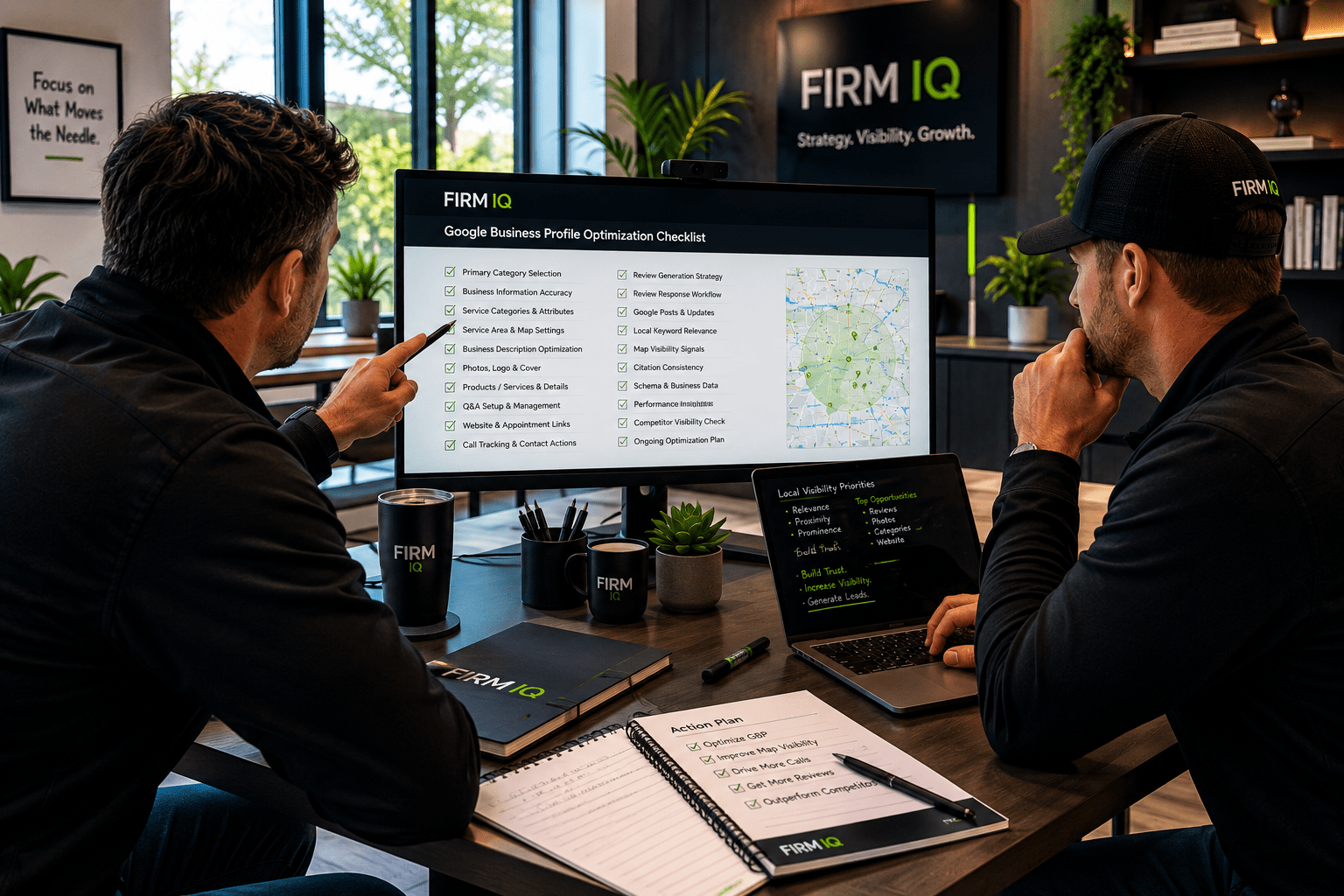
Review your categories, services, business information, photos, reviews, calls, messaging, and conversion paths.
Identify whether your GBP is supported by your website, citations, schema, service pages, location pages, and tracking.
Find the gaps that may keep your business from showing up, earning trust, and turning local searches into calls or inquiries.
Firm IQ Google Business Profile checklist for local businesses reviewing categories, services, photos, reviews, calls, map visibility, and local discovery signals
GBP Checklist Your profile should be more than complete. It should be connected to the foundation that helps local customers choose you.
How To Use This Checklist

Do Not Just Check Whether The Profile Exists

A Google Business Profile can be filled out and still underperform. The real question is whether the profile clearly represents the business, supports the services customers search for, reinforces trust, and connects to the rest of your visibility foundation.

0 Missing, inaccurate, or not set up.
1 Exists, but is incomplete or weak.
2 Mostly complete, but not fully supported.
3 Complete, accurate, connected, and useful.
How to score yourself:

Give each section a score from 0 to 3. Anything below a 2 should be treated as a visibility gap. Anything that affects categories, services, business information, reviews, tracking, or website support should be prioritized first.

Step 1

Business Identity And Core Information

Start with the basics. Google needs to understand who the business is, where it is located, how customers contact it, and whether the information matches what appears across the web.

The business name exactly matches the real-world business name and is not stuffed with keywords or cities.
The primary phone number is correct, active, and connected to call tracking only if tracking is configured properly.
The website URL points to the best page for the business, not a broken page, tracking error, old domain, or generic landing page.
The address, service area, or hybrid business setup accurately reflects how the business serves customers.
Hours are accurate, including holiday hours, emergency hours, or appointment-only details where relevant.
The business information matches major citations, directory listings, website footer, schema, and contact page.
Step 2

Categories And Services

Categories and services help Google understand what the business does. This is one of the most important parts of the profile because category choices can shape when the business is eligible to appear.

The primary category reflects the core service or business type most closely tied to revenue.
Secondary categories support real services without adding irrelevant or misleading categories.
Services are listed clearly and match the services explained on the website.
Service descriptions are useful, natural, and written for customers, not stuffed with city names or repeated keywords.
High-value services have supporting pages on the website that explain the service in more depth.
The profile is not missing important services that competitors are clearly targeting.
Step 3

Business Description And Positioning

The description should make the business easier to understand. It should not read like a pile of keywords. It should clearly explain what the business does, who it serves, where it operates, and why customers should care.

The description explains the business clearly in plain language.
The most important services are mentioned naturally.
The description includes market or service-area context where appropriate.
The copy avoids exaggerated claims, keyword stuffing, fake awards, or language that does not match the website.
The positioning aligns with what customers see on the homepage, service pages, and contact page.
Step 4

Photos, Visual Proof, And Media

Photos help customers decide whether the business is active, legitimate, and trustworthy. For many local businesses, photos also support service proof, team trust, project quality, location credibility, and customer confidence.

The profile has current photos, not only old, generic, low-quality, or stock-style images.
Photos reflect the real business, team, office, vehicles, projects, work quality, or customer experience where appropriate.
Service-area businesses include useful proof such as work examples, branded vehicles, team photos, or project-related imagery.
Office-based businesses include credible exterior, interior, team, signage, and professional environment photos where appropriate.
New photos are added consistently enough to show that the business is active.
Step 5

Reviews And Reputation Signals

Reviews are not just star ratings. They are proof. The words customers use in reviews can help future customers understand what the business does, what the experience is like, and why people trust it.

The business has a steady review acquisition process that does not rely on random chance.
Recent reviews reflect the services the business actually wants more of.
Reviews mention real service details, customer problems, locations, outcomes, or experience when naturally provided by customers.
Positive and negative reviews are responded to professionally.
The review profile is competitive compared to businesses currently ranking in the top local results.
The website uses reviews or testimonials to support service and location pages where appropriate.
Step 6

Calls, Messaging, Booking, And Conversion Paths

Visibility only matters if customers can take action. A Google Business Profile should make it easy for potential customers to call, message, book, request help, get directions, or visit the right page.

The phone number works and is answered by someone who can handle new inquiries.
Messaging or booking features are enabled only if the business can respond quickly and consistently.
Website links send visitors to pages with clear calls to action, not confusing or generic pages.
Call tracking is configured so the business can understand which visibility sources create phone inquiries.
Form tracking is set up so leads from the website can be connected to visibility work.
The business reviews call quality, not just call count.
Step 7

Website Support For The GBP

A Google Business Profile performs better when the website supports what the profile says. If the profile lists services the website barely explains, or serves markets the website does not support, the foundation is weaker.

The homepage clearly explains who the business serves, what it does, and where it operates.
Core services listed in GBP have useful service pages on the website.
Important markets or service areas have useful location support where appropriate.
The contact page, footer, schema, and GBP all reinforce the same business identity.
Pages have clear calls to action that match how customers want to contact the business.
The website is not relying on thin, duplicate city pages that do not earn visibility or trust.
Step 8

Citations, Directories, And External Consistency

Your GBP is not the only place Google and customers can find your business. External sources should reinforce the same name, address, phone number, website, categories, services, and business identity.

Major citation sources show the correct business name, phone number, address or service area, and website.
Duplicate or outdated listings are identified and cleaned up where possible.
Industry-specific directories support the business category and services.
Local sources, chambers, associations, sponsorships, or community profiles support legitimacy where relevant.
External listings do not conflict with the website or Google Business Profile.
Step 9

Competitor Gap Review

A profile should not be reviewed in isolation. Compare it against the businesses already showing up ahead of you. The goal is to identify what the market sees in competitors that it may not yet see in your business.

Compare categories used by top competitors.
Compare review volume, review recency, review quality, and review language.
Compare services, photos, posts, Q&A, and profile completeness.
Compare competitor websites to see which services and markets they support better.
Identify whether competitors look more complete, more trusted, or easier to choose.
Step 10

Tracking And Outcome Review

GBP work should not be measured only by whether the profile looks complete. Measure whether it contributes to calls, forms, direction requests, bookings, quote requests, and qualified opportunities.

GBP calls are tracked and reviewed for quality.
Website forms are tracked and tied to source where possible.
Direction requests, website clicks, booking actions, and call clicks are monitored.
The business reviews which services and locations generate the best opportunities.
Reporting connects visibility work to real business movement, not just dashboard activity.
After The Checklist

Turn Your Findings Into A Visibility Action Plan

Once you complete the checklist, group your findings into four buckets: missing information, weak profile signals, unsupported website signals, and tracking gaps. The goal is not to randomly update the profile. The goal is to strengthen the foundation around the profile.

Fix incorrect business information first.
Strengthen categories, services, photos, reviews, and profile completeness.
Build or improve website pages that support the profile.
Add tracking so visibility work can be tied to calls and inquiries.
FAQ

Google Business Profile Checklist FAQ

These are the questions local business owners often ask when they realize a complete profile is not always the same thing as a profile that creates visibility and demand.

Is completing my Google Business Profile enough to rank in Google Maps?

No. Completing your profile is important, but it is only one part of local visibility. Your profile is supported by your website, categories, services, reviews, citations, business consistency, local relevance, user behavior, and competitor strength. A complete profile can still underperform if the rest of the visibility foundation is weak.

What is the most important part of a Google Business Profile?

The most important parts are accurate business information, the right primary category, relevant services, strong reviews, useful photos, clear contact paths, and website support. The profile should clearly match the real business and be reinforced by the website and external business signals.

How often should a business update its Google Business Profile?

A business should update its profile whenever business information changes and should review it regularly for accuracy. Photos, reviews, services, hours, and profile details should not be ignored for long periods. An active and accurate profile usually looks more trustworthy than one that appears neglected.

Do reviews help Google Business Profile visibility?

Reviews can help customers trust the business and can support local visibility when they reflect real services, customer experiences, and recent activity. Review volume, quality, recency, and content all matter. A review strategy should focus on legitimate customer feedback, not shortcuts or fake activity.

Why does my website matter if customers find me on Google Maps?

Your website helps support what the Google Business Profile says. If your profile lists important services but your website does not explain them, the foundation is weaker. A strong website gives Google and customers more context about your services, locations, credibility, proof, and next steps.

What should I track from my Google Business Profile?

Track calls, website clicks, direction requests, booking actions, form submissions, source attribution, and lead quality where possible. Do not stop at profile views or dashboard activity. The real question is whether your profile is contributing to qualified opportunities.

Related Resources

Keep Building The Foundation

Your Google Business Profile is only one part of local visibility. These resources help you review the pages, location signals, and broader structure that support it.

Want A Second Set Of Eyes?

Find Out What Your GBP Is Missing

The Atlas Gap Analysis reviews how your Google Business Profile is supported by your website, citations, reviews, services, location signals, tracking, and competitor visibility. The goal is to identify what is holding back real market movement.

Identify missing or weak profile signals.
Compare your profile against competitors showing ahead of you.
See whether the rest of your website supports your GBP.