
The Most Effective Local SEO Strategy For Chandler, AZ Businesses
The best local SEO strategy for Chandler, AZ businesses is not a pile of disconnected tactics. It is a visibility system that connects your website, Google Business Profile, Google Maps signals, reviews, citations, service pages, location coverage, schema, and tracking so customers can find and trust you faster.
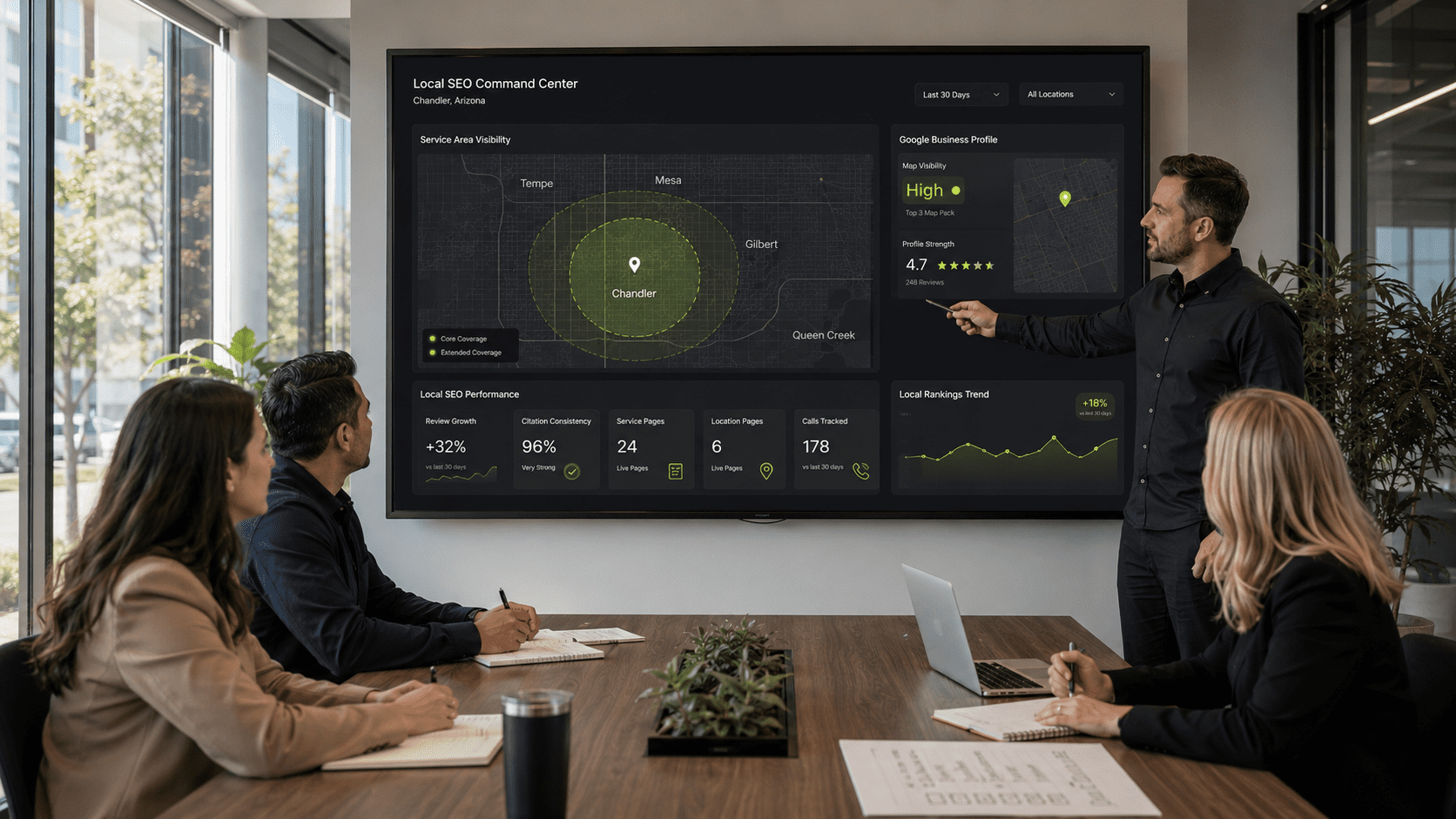
Local SEO in Chandler, AZ has changed. The old playbook was simple: add keywords to a website, claim a Google listing, build a few backlinks, and wait. That approach is not enough anymore, especially for local businesses competing across Chandler, Gilbert, Mesa, Tempe, Phoenix, Scottsdale, and the broader East Valley.
Today, the local businesses that win are usually not the ones doing the most random marketing activity. They are the ones with the clearest visibility foundation. Their service pages explain what they do. Their Google Business Profile supports those services. Their reviews build trust. Their citations are consistent. Their website architecture makes sense. Their local signals help Google and AI understand the business.
That is the real purpose of a local SEO strategy. It should make your business easier to find, easier to understand, easier to trust, and easier to recommend when a local buyer is ready to call, schedule, request a quote, or compare providers.
The most effective local SEO strategy is not about chasing one keyword. It is about building the recommendation signals that help your business show up across Google Search, Google Maps, AI search, directories, and local discovery channels.
Why Local SEO Strategy Matters In Chandler
Chandler is a strong local market, but it is not isolated. A customer searching for a service in Chandler may see businesses from nearby cities. A home service company may compete across several service areas. A dental office, med spa, law firm, or consultant may compete with both local specialists and larger regional brands.
This creates a visibility problem. If your business is only partially built out online, competitors can look more relevant and more trustworthy even if your actual service is better. They may have stronger Google Business Profile signals, more complete service pages, better reviews, clearer market coverage, more consistent citations, or stronger internal linking.
A good local SEO strategy identifies those gaps and fixes them in the right order. It does not start by asking, “How do we rank for more keywords?” It starts by asking, “What does Google, Google Maps, AI search, and a real customer need to understand before recommending or choosing this business?”
Step 1: Define The Services That Actually Drive Revenue
The first step is service clarity. Many local business websites are too vague. They list broad services but do not explain each one in enough depth. That makes it harder for search engines to understand the business and harder for customers to decide whether they are in the right place.
A Chandler HVAC company should not rely on one general “HVAC services” page if AC repair, AC replacement, heating repair, maintenance, and emergency service are all important. A law firm should not bury estate planning, probate, business law, and real estate matters on one thin page. A dentist should not expect one services page to cover cleanings, implants, cosmetic dentistry, Invisalign, emergency dentistry, and family dentistry well.
Your local SEO strategy should begin with the services that create the best customers, highest-value opportunities, and strongest buyer intent. Those services need useful pages, not keyword-stuffed placeholders.
Step 2: Build Service Pages That Match Search Intent
A strong service page does more than mention a keyword. It explains the problem, the service, the process, the local relevance, the proof, and the next step. It should help a real customer understand whether your business can solve their issue.
The page should also help Google and AI systems connect your business to the service. That means clear headings, helpful copy, FAQs, internal links, relevant calls to action, and schema where appropriate.
A useful service page usually includes:
- A clear explanation of the service.
- Common problems or situations the customer is facing.
- What your process looks like.
- Who the service is best for.
- Trust signals such as reviews, experience, photos, or credentials.
- Internal links to related services and local pages.
- A simple call, form, scheduling, or quote action.
Thin service pages rarely create strong visibility. Better service pages improve both search relevance and conversion.
Step 3: Strengthen Your Google Business Profile
For many Chandler businesses, the Google Business Profile is the most visible local asset. It appears in Google Search, Google Maps, and the local map pack. A potential customer may compare your reviews, photos, services, hours, and call button before they ever visit your website.
Your profile should be complete, accurate, and aligned with your website. Your primary category should reflect your core business. Secondary categories should support real services. Hours should be current. Photos should be real. Services should be filled out. Reviews should be answered. The website link should point to a page that supports the profile.
Google Business Profile optimization is not a one-time setup. It should be maintained. A neglected profile can make an active business look quiet. An accurate, useful, and current profile can make a business easier to choose.
Step 4: Create Real Location And Market Coverage
Local SEO strategy also needs market clarity. For a Chandler business, this may include the city itself, nearby neighborhoods, and surrounding service areas. But market coverage must be handled carefully.
Many businesses make the mistake of creating dozens of nearly identical city pages with only the city name swapped out. That is not a strong strategy. It creates low-value pages that do little for customers and may weaken the overall quality of the site.
Better location and service-area pages should provide real value. They should explain your connection to the market, the services available there, common local needs, relevant proof points, and how customers can take the next step. For service-area businesses, this can help clarify where you work without pretending to have offices where you do not.
Step 5: Build A Review System
Reviews are one of the most important trust signals in local search. A customer comparing businesses in Chandler may look at rating, review count, review recency, review content, and how the owner responds.
A strong review system is simple and consistent. Ask real customers for honest feedback after a successful job, visit, case, appointment, or project. Make the process easy with a direct review link. Train your team to ask at the right moment. Respond to reviews in a professional way.
Do not script reviews, buy reviews, or ask customers to stuff keywords into them. That creates risk and feels unnatural. The goal is to earn authentic feedback that helps future customers understand the experience of working with your business.
Step 6: Clean Up Citations And Directory Listings
Citations are mentions of your business across directories, data platforms, navigation apps, industry sites, and local listings. They often include your name, address, phone number, website, categories, and hours.
Inconsistent citations can create confusion. If one platform shows an old address, another has the wrong phone number, and another lists the wrong category, your business signals become messy. This is especially common for companies that have moved, rebranded, added locations, changed phone numbers, or expanded service areas.
Your local SEO strategy should include citation cleanup and directory consistency. Focus on accuracy before volume. The goal is to make your business data reliable across the platforms customers and search systems use.
Step 7: Use Schema To Clarify Meaning
Schema markup helps search engines interpret your website content. It does not replace strong pages, but it can reinforce important details about your business, services, location, FAQs, articles, and page structure.
Local businesses often benefit from LocalBusiness schema, Service schema, FAQ schema, Breadcrumb schema, and Article schema for educational content. The schema should match what is visible on the page. It should not include unsupported claims.
When paired with strong service pages, clear business information, reviews, and internal links, schema can help create a cleaner understanding of your business.
Step 8: Improve Internal Linking
Internal linking is one of the easiest ways to improve website clarity. It helps visitors find related information and helps search engines understand how your pages connect.
A service page might link to related services, an FAQ, a Google Business Profile guide, and a location page. A blog post might link to a service page, a checklist, a process page, or an Atlas Gap Analysis. The links should feel natural and useful, not forced.
Good internal linking turns your website from a loose collection of pages into a connected local visibility system.
Step 9: Track Calls, Forms, And Lead Quality
Rankings are useful, but they are not the final score. A local SEO strategy should be judged by visibility, calls, form submissions, booked appointments, qualified leads, and revenue opportunities.
Use analytics, Google Business Profile performance data, UTM-tagged links, form tracking, and call tracking where appropriate. Look at which pages produce opportunities. Look at which services attract qualified buyers. Look at whether Google Maps is driving calls. Look at whether your website helps people take action.
This turns SEO from a vague marketing expense into a more practical business system.
Where Atlas™ Fits Into Local SEO Strategy
Firm IQ uses Atlas™ as the visibility foundation for local businesses. Atlas includes the practical work that helps Google, Google Maps, AI search tools, local directories, navigation platforms, and customers better understand the business.
That can include website service pages, location pages, market pages, Google Business Profile signals, reviews, citations, directory listings, local business schema, service schema, internal links, tracking, AI visibility briefs, business signals, and market coverage.
The advantage of this approach is that the pieces are not treated separately. Your website supports your profile. Your profile supports local discovery. Reviews support trust. Citations support consistency. Schema supports clarity. Tracking supports better decisions. Together, the system becomes stronger than isolated SEO tasks.
What Chandler Businesses Should Avoid
Avoid any local SEO strategy built on shortcuts. Be careful with keyword stuffing, fake reviews, duplicate city pages, spammy backlinks, vague ranking promises, and reporting that ignores calls or lead quality.
Also avoid making everything about traffic. A page that produces ten qualified calls may be more valuable than a page that gets hundreds of low-intent visits. A Google Business Profile that drives ready-to-call customers may be more important than a blog post that attracts readers outside your market.
Local SEO should support business outcomes. It should help the right people find you, trust you, and take action.
The Bottom Line
The most effective local SEO strategy for Chandler, AZ businesses is a connected visibility system. It starts with clear services, strong website architecture, a complete Google Business Profile, real reviews, accurate citations, useful schema, smart internal links, local market coverage, and tracking.
You do not need generic SEO noise. You need a practical system that shows Google and AI what your business does, where you serve, and why customers trust you.
Great businesses do not always get found. The businesses that Google and AI understand most clearly are often the businesses that get recommended.
Want to know where your local SEO strategy is weak? Request an Atlas Gap Analysis. Firm IQ compares how your business is currently being found against competitors showing up ahead of you, then identifies visibility gaps, market coverage opportunities, and recommendation signals Google and AI may be missing.
FAQ: Local SEO Strategy For Chandler, AZ Businesses
What is the best local SEO strategy for a Chandler business?
The best local SEO strategy for a Chandler business is a connected visibility system that includes service pages, Google Business Profile optimization, reviews, citations, schema, internal links, local market coverage, and tracking.
Does Google Business Profile affect local SEO?
Yes. Google Business Profile can strongly affect how a local business appears in Google Search, Google Maps, and the local map pack. Categories, services, hours, photos, reviews, and profile accuracy all help customers and Google understand the business.
Do Chandler businesses need location pages?
Some Chandler businesses benefit from location or service-area pages, especially if they serve multiple markets. These pages should be useful and specific, not duplicated pages with only city names changed.
How important are reviews for local SEO?
Reviews are important because they support trust, customer decision-making, and local visibility signals. A consistent review process with real customer feedback and professional responses can strengthen a business’s online presence.
How can Firm IQ help improve local SEO strategy?
Firm IQ’s Atlas Gap Analysis compares your current visibility against competitors showing up ahead of you. It identifies gaps in your website, Google Business Profile, reviews, citations, schema, service coverage, market coverage, and recommendation signals.