
The Key SEO Components Chandler, AZ Businesses Need
A strong SEO strategy in Chandler, AZ is not one tactic. It is a connected set of components that help Google, Google Maps, AI search tools, and local customers understand your services, your market coverage, your credibility, and the next step to work with you.
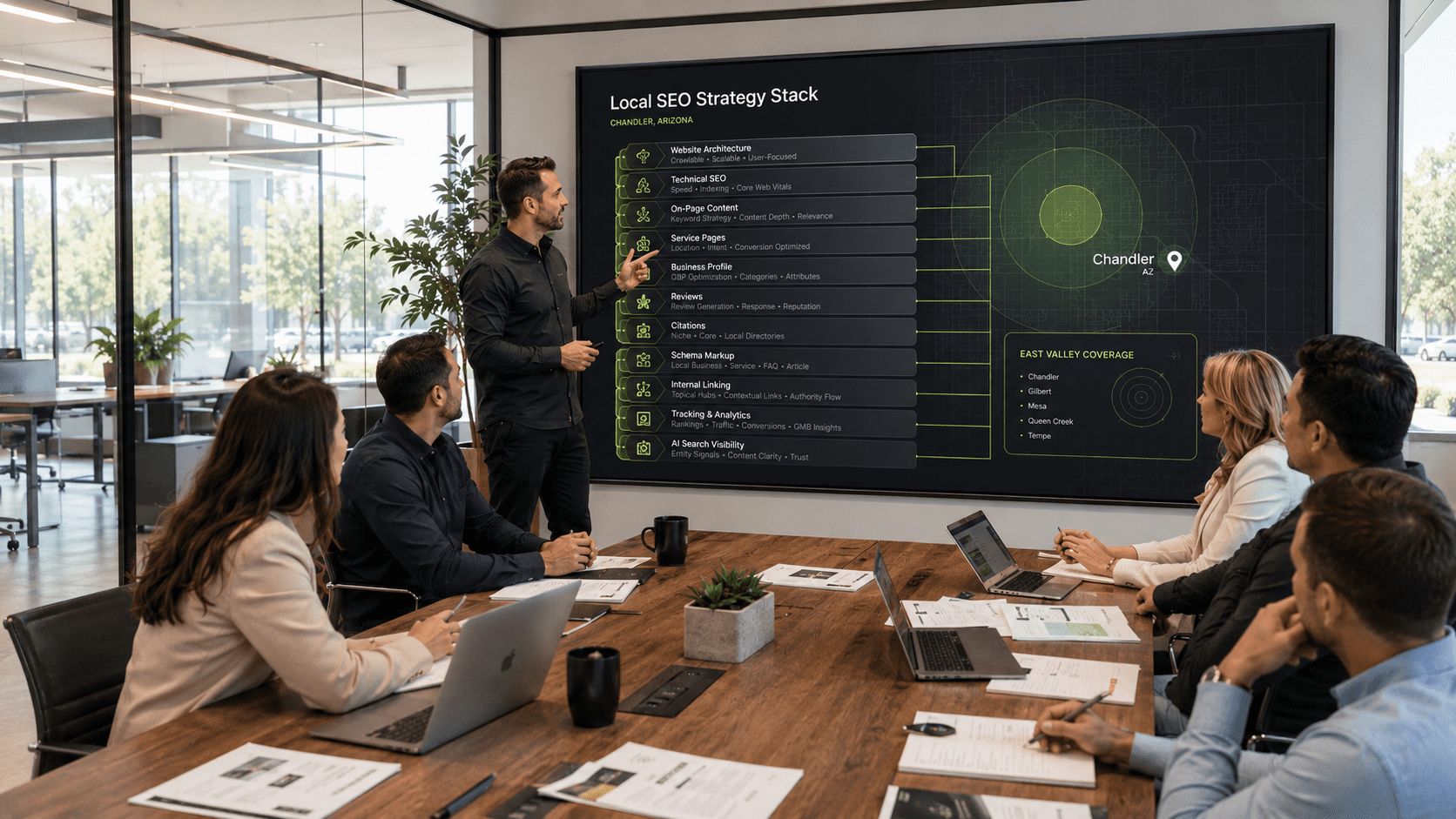
When most local business owners think about SEO, they usually think about rankings. That is understandable, but it is incomplete. Rankings are the visible result of many underlying signals. If those signals are weak, inconsistent, or disconnected, the business may struggle to show up even if it provides excellent service.
For Chandler businesses, SEO has to support more than a website. Customers discover local companies through Google Search, Google Maps, Google Business Profiles, directory listings, review platforms, navigation apps, AI search tools, and referrals. A strong SEO strategy needs to make the business clear across those discovery points.
The key components of SEO in Chandler, AZ include website architecture, technical health, on-page content, service pages, Google Business Profile signals, reviews, citations, schema markup, internal links, market coverage, and tracking. Each component has a role. The best results come when they support each other.
Good SEO is not about adding more noise. It is about making your business easier to find, easier to understand, easier to trust, and easier to recommend.
Component 1: Website Architecture
Website architecture is the structure behind your visibility. It determines how your pages are organized, how services are explained, how locations are connected, and how easily visitors can move from research to action.
Many local business websites are too thin. They have a homepage, an about page, a contact page, and one broad services page. That may be enough for a basic online presence, but it is often not enough for competitive local visibility.
A better structure gives each important service and market the right level of clarity. It helps Google understand what you offer and helps customers find the page that matches their problem.
- A homepage that clearly explains the business and primary market.
- Dedicated service pages for high-value offers.
- Location or service-area pages where market coverage matters.
- Helpful FAQ sections that answer buyer questions.
- Internal links that connect related services, locations, and resources.
- Clear calls to action for calls, forms, quotes, or scheduling.
Component 2: Technical SEO
Technical SEO helps ensure your website can be crawled, loaded, understood, and used properly. It is not the most exciting part of local visibility, but it matters because technical problems can hold back otherwise useful content.
For a Chandler business, the technical foundation should include mobile-friendly layouts, fast page loading, clean URLs, indexable pages, secure HTTPS, proper redirects, optimized images, sitemap access, and no major crawl errors.
Technical SEO should support the user experience. A potential customer should not struggle with a slow page, broken button, confusing navigation, or layout that is difficult to use on a phone. Local buyers often search while they are ready to act. Friction costs opportunities.
Component 3: On-Page SEO And Content Clarity
On-page SEO is about making each page clear. That includes the title, headings, body copy, internal links, images, FAQs, and calls to action. The page should match the intent of the person searching.
Keyword usage still matters, but keyword stuffing does not. A page about AC repair in Chandler should naturally explain AC repair, symptoms, timing, service process, local availability, and the next step. It should not repeat the same phrase awkwardly until it becomes unreadable.
The best on-page content is useful to a real buyer and clear to search systems. It explains what the business does, who it helps, where it serves, and why the customer should trust it.
Component 4: Service Pages
Service pages are one of the highest-impact SEO components for local businesses. A homepage cannot rank well or convert well for every service. Each major revenue-driving service usually deserves a dedicated page.
A dentist may need pages for implants, cosmetic dentistry, emergency dentistry, Invisalign, cleanings, and family dentistry. A contractor may need pages for specific repair, installation, replacement, or maintenance services. A law firm may need pages for each major practice area.
A strong service page should explain the service, common problems, who it is for, what the process looks like, related services, relevant local context, trust signals, FAQs, and a clear next step.
Component 5: Google Business Profile
The Google Business Profile is one of the most important local visibility assets for Chandler businesses. It influences how a business appears in Google Maps, the local map pack, and branded search results.
A strong profile should include accurate business information, the right primary category, useful secondary categories, complete services, current hours, real photos, strong review activity, and a website link that supports the customer’s intent.
The profile should also align with the website. If your Google Business Profile lists services that are not explained on the site, the business picture is incomplete. If your website describes market coverage that is not reflected in business signals, clarity suffers.
Component 6: Reviews And Reputation
Reviews help customers decide whether to trust you. They also reinforce that the business is active and serving real customers. Review count, rating, recency, content, and owner responses all influence the way a business is perceived.
A strong review strategy should be ethical and consistent. Ask real customers for honest feedback. Make it easy with a direct review link. Respond professionally. Avoid fake reviews, incentives that violate platform rules, or scripted keyword-heavy requests.
Good reviews help buyers understand the experience of working with your business. They can mention responsiveness, professionalism, service quality, timing, location, and specific problems solved.
Component 7: Citations And Directory Listings
Citations are mentions of your business data across directories, map platforms, navigation apps, industry sites, and local data sources. They usually include your name, address, phone number, website, hours, and categories.
Citation consistency helps reduce confusion. If one platform has an old phone number, another has a previous address, and another lists the wrong category, your business signals become less reliable.
This matters for businesses that have moved, rebranded, added locations, changed phone numbers, or expanded service areas. The goal is not to appear on every directory possible. The goal is to make the important listings accurate and aligned.
Component 8: Schema Markup
Schema markup helps search engines interpret the meaning of your content. It does not replace strong pages, but it can clarify business details, services, FAQs, article content, breadcrumbs, and other structured information.
Common schema opportunities for local businesses include LocalBusiness schema, Service schema, FAQ schema, Breadcrumb schema, and BlogPosting schema. The information in the schema should match the visible page content.
Schema works best when the page itself is already useful. It is a clarity layer, not a shortcut.
Component 9: Internal Linking
Internal links connect the pieces of your website. They help visitors discover related content and help search engines understand page relationships.
A service page can link to related services, local pages, FAQs, and resources. A blog post can link to a deeper service page, a checklist, or an Atlas Gap Analysis. A location page can link to services available in that market.
Good internal linking should feel natural. It should guide the reader toward the next useful page, not force links into every paragraph.
Component 10: Market Coverage
Chandler businesses often serve more than one immediate area. Depending on the business, market coverage may include Chandler, Gilbert, Mesa, Tempe, Phoenix, Scottsdale, Sun Lakes, or other East Valley communities.
Your website and business signals should clarify where you actually serve customers. This does not mean creating dozens of duplicate city pages. It means building useful location or service-area content where it helps the customer and supports the real business model.
Strong market coverage helps Google, AI tools, and buyers understand the relationship between your services and your service area.
Component 11: Tracking And Measurement
SEO should be measured by more than rankings. Rankings are useful, but they do not tell you whether the work is producing calls, forms, scheduled appointments, direction requests, qualified leads, or revenue opportunities.
Tracking should include website analytics, Google Business Profile performance, UTM-tagged profile links, form submissions, call activity, and page-level performance. The goal is to see which visibility channels and pages create real business outcomes.
Without tracking, local SEO becomes opinion. With tracking, it becomes a practical operating system for better decisions.
How These Components Work Together
The key SEO components are strongest when they are connected. Service pages support Google Business Profile relevance. Reviews support trust. Citations support consistency. Schema supports clarity. Internal links support discovery. Tracking supports better prioritization.
Firm IQ uses Atlas™ as a visibility foundation for this reason. Atlas includes the work needed to help Google, Google Maps, AI search tools, directories, and customers better understand a business: service pages, location pages, market pages, Google Business Profile signals, reviews, citations, directory listings, schema, internal links, tracking, AI visibility briefs, and market coverage.
The objective is not to make SEO more complicated. The objective is to build a clearer system.
The Bottom Line
The key components of a strong SEO strategy in Chandler, AZ include technical health, website architecture, service pages, Google Business Profile optimization, reviews, citations, schema, internal links, market coverage, and tracking.
A business does not need generic SEO activity. It needs a visibility foundation that helps customers and search systems understand the business clearly.
Great businesses do not always get found. The businesses that Google and AI understand most clearly are often the businesses that get recommended.
Want to know which SEO components are missing or weak? Request an Atlas Gap Analysis. Firm IQ compares how your business is currently being found against competitors showing up ahead of you, then identifies visibility gaps, market coverage opportunities, and recommendation signals Google and AI may be missing.
FAQ: SEO Components For Chandler, AZ Businesses
What are the main components of SEO?
The main components of SEO include technical SEO, website architecture, on-page content, service pages, Google Business Profile signals, reviews, citations, schema markup, internal linking, market coverage, and tracking.
Which SEO component matters most for local businesses?
There is no single component that does all the work. For local businesses, the highest-impact components are usually service pages, Google Business Profile optimization, reviews, citation consistency, website structure, and tracking.
Is technical SEO important for Chandler businesses?
Yes. Technical SEO helps make sure your site is fast, mobile-friendly, crawlable, secure, and usable. It supports the rest of your local visibility strategy by reducing friction for customers and search engines.
How do reviews fit into an SEO strategy?
Reviews support customer trust and local visibility. Real, recent, detailed reviews can help buyers compare businesses and can reinforce the credibility of your Google Business Profile and broader online presence.
How can Firm IQ identify weak SEO components?
Firm IQ’s Atlas Gap Analysis compares your business against competitors showing up ahead of you. It reviews website structure, service pages, Google Business Profile signals, reviews, citations, schema, internal links, market coverage, and tracking.