Firm IQ logo
480-696-1247
Call Now
Firm IQ Resources Location Page Checklist
Location Page Checklist

Location Page Checklist For Local Businesses

A location page should prove local relevance. It should not be a city-name swap that exists only because someone wanted another keyword page. Use this checklist to review whether your location pages are useful, locally supported, internally connected, credible, and capable of helping customers and search platforms understand where you serve.
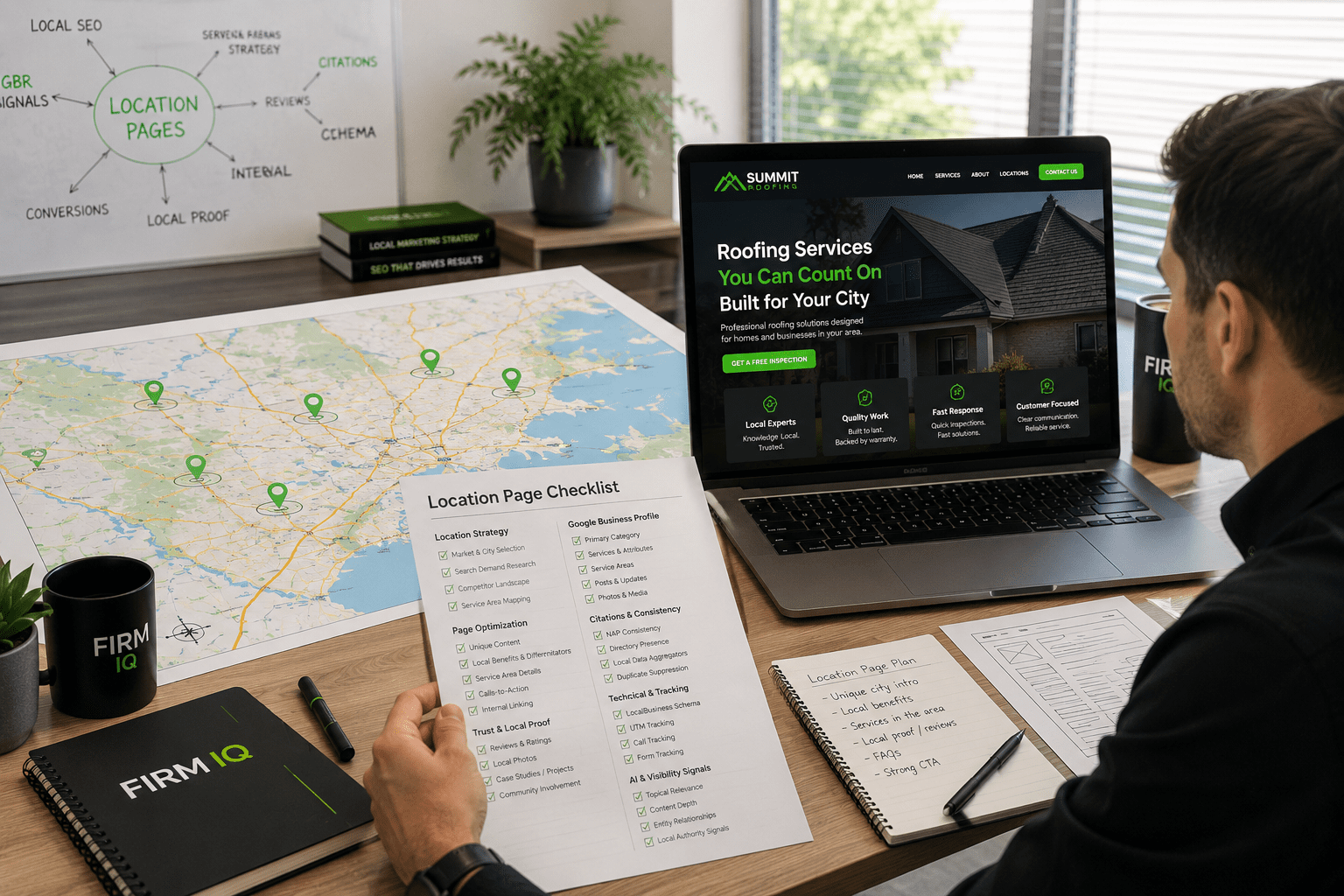
Review whether each location page has real market purpose, local context, service relevance, proof, FAQs, and a clear next step.
Identify city-name swap pages, duplicate pages, unsupported service-area pages, and location pages that do not deserve visibility.
Connect location pages to your Google Business Profile, service pages, citations, reviews, schema, internal links, and conversion tracking.
Firm IQ location page checklist for local businesses reviewing city pages, service-area relevance, local proof, internal links, Google Business Profile support, schema, and conversions
Location Page Checklist A location page should prove local relevance, not just repeat a city name and hope Google cares.
How To Use This Checklist

Do Not Build Location Pages Just To Have More Pages

A weak location page can make a site look bigger without making the business easier to choose. The question is whether the page helps customers understand your relevance to that market and helps search platforms connect your services, proof, and business identity to that location.

0 Missing, duplicate, or not useful.
1 Mostly a city-name swap with little substance.
2 Useful, but missing proof, links, or market support.
3 Locally relevant, credible, connected, and measurable.
How to score yourself:

Give every location page a score from 0 to 3. Pages below a 2 should be improved, consolidated, or removed from the active strategy. Strong location pages have a reason to exist beyond targeting another city keyword.

Step 1

Market Purpose And Page Justification

Every location page needs a real reason to exist. The page should support a real market, real customer demand, real service coverage, or a real office/location presence.

The page targets a city, town, neighborhood, region, office market, or service area the business actually serves.
The market has real business value, not just a keyword someone found in a tool.
The page supports a service area, physical location, territory, route, franchise market, or expansion strategy.
The business can clearly explain why customers in this location should contact it.
The page has enough unique context to avoid being a duplicate of other location pages.
Step 2

Headline, Introduction, And Local Clarity

A location page should tell visitors where they are, what the business offers there, and why the page matters. It should not open with awkward keyword-stuffed language.

The H1 clearly identifies the service category and location without sounding spammy.
The opening copy explains what the business offers in that market.
The page quickly establishes whether the business has a physical office, service-area coverage, or nearby market presence.
The first screen includes a clear contact path, such as call, request a quote, schedule, book, or request a consultation.
The page avoids generic intros that could apply to any company in any city.
Step 3

Local Context And Service-Area Relevance

Local context should be useful and natural. The page should show familiarity with the market without stuffing landmarks, ZIP codes, neighborhoods, and city names just to look local.

The page includes useful local context that helps customers understand the business serves that market.
Nearby neighborhoods, corridors, suburbs, towns, or service zones are mentioned only when they are relevant and accurate.
The page explains any local service considerations, response patterns, office proximity, route density, market familiarity, or customer needs where appropriate.
The copy does not pretend the business has local presence where it does not.
The location page supports the real way the business serves customers in that area.
Step 4

Service Relevance On The Location Page

A location page should connect the market to the services customers need. It should not simply say the business serves a city and then leave visitors guessing what they can actually hire you for.

The page clearly lists or explains the core services available in that location.
Important services link to deeper service pages.
The service descriptions are adapted to the location where relevant, not copied word-for-word across every city page.
The page avoids listing services the business does not actually provide in that market.
The page helps customers understand which service best fits their need before contacting the business.
Step 5

Local Proof, Reviews, And Trust Signals

Location pages work better when they include proof that supports the market. That may include reviews, testimonials, project examples, local photos, office details, service routes, nearby work, or credible local references.

The page includes reviews, testimonials, examples, photos, projects, case notes, or proof relevant to that market where available.
Proof supports the actual service and location relationship, not random testimonials pasted everywhere.
The page shows trust signals such as credentials, licenses, team details, experience, office details, or business history where relevant.
The page avoids fake local claims, fake offices, fake local photos, or unsupported statements.
The page makes the business easier to trust for customers in that location.
Step 6

Google Business Profile Alignment

Location pages should support your Google Business Profile strategy. For single-location businesses, they should reinforce the primary profile. For multi-location businesses, they should support the correct location profile without creating confusion.

The page aligns with the correct Google Business Profile, office, service area, or market structure.
The business name, address, phone number, and website links match the intended entity setup.
The page reinforces services, categories, and market relevance shown in the profile.
For multi-location businesses, each page points customers toward the right office, profile, or contact path.
The page does not create conflicting location signals that could confuse customers or search platforms.
Step 7

Internal Links And Site Architecture

Location pages should connect to the rest of the site. They should not be orphan pages buried in a sitemap. Strong internal linking helps users and search platforms understand how services and markets relate.

The location page links to relevant service pages.
Relevant service pages link back to location pages where the connection makes sense.
The page is linked from a location hub, service-area hub, navigation, footer, or related market pages where appropriate.
The page links to related resources, case studies, testimonials, contact pages, or proof assets when useful.
The internal links help visitors and search platforms understand priority markets and service relationships.
Step 8

Citations, Directories, And External Location Signals

External sources should support the location strategy, especially for businesses with physical offices, multiple locations, franchise territories, or service-area markets.

Major citations and directories are consistent with the business location or service-area setup.
Location-specific listings point to the correct page where appropriate.
Local associations, chambers, sponsorships, community pages, industry directories, or regional profiles support legitimacy where relevant.
Duplicate listings, old addresses, wrong phone numbers, and outdated URLs are identified and corrected where possible.
External location signals reinforce the same entity information shown on the website and Google Business Profile.
Step 9

Schema And Structured Location Signals

Schema should clarify the page, business, service area, breadcrumbs, location relationship, and visible page content. It should not create fake locations or make claims that are not shown on the page.

The page uses appropriate structured data where relevant, such as WebPage, BreadcrumbList, LocalBusiness, Service, FAQPage, or location-related schema.
The schema matches the visible content and does not invent offices, addresses, or service areas.
The URL, page name, business identity, area served, and contact information are accurate.
FAQ schema is only used when the questions and answers are visible on the page.
The schema supports the broader business entity instead of creating conflicting location information.
Step 10

Conversion Paths And Outcome Tracking

Location pages should be measured by more than whether they rank. The goal is to understand whether they contribute to calls, quote requests, appointments, consultations, directions, bookings, and qualified opportunities from that market.

The page includes clear calls to action near the top, middle, and bottom where appropriate.
Calls, forms, bookings, quote requests, consultation requests, or direction actions are trackable where possible.
The business reviews whether the page creates qualified opportunities from that location.
Performance is compared against competitor visibility and actual market value.
The page is improved over time based on visibility, engagement, calls, forms, and lead quality.
After The Checklist

Fix Weak Location Pages Before Building More Of Them

More location pages do not automatically create more visibility. Start by improving the markets that matter most. A strong location page should connect service relevance, local proof, internal links, GBP support, citations, schema, and conversion tracking.

Prioritize locations with real customer demand and business value.
Improve or consolidate duplicate city-name swap pages.
Connect location pages to service pages, GBP signals, citations, reviews, and schema.
Track whether location visibility turns into calls, forms, appointments, or quote requests.
FAQ

Location Page Checklist FAQ

These are the questions local business owners should ask before building more city pages, service-area pages, franchise market pages, or office location pages.

What makes a location page good?

A good location page clearly explains the market served, the services available there, why the business is relevant to that location, what proof supports the relationship, and what the visitor should do next. It should help customers and search platforms understand local relevance without relying on keyword stuffing.

Are city-name swap pages bad?

City-name swap pages are usually weak because they often repeat the same content with only the city name changed. A useful location page should include real service relevance, local context, internal links, proof, FAQs, conversion paths, and accurate business information. Local SEO is not bad. Lazy local SEO is bad.

Should every city have its own page?

Not always. A city usually deserves its own page only when the business truly serves that market and there is enough demand, value, context, and proof to support a useful page. Some nearby cities or smaller markets may be better handled through a broader service-area page or location hub.

How do location pages support Google Business Profile visibility?

Location pages can support Google Business Profile visibility by reinforcing the services, market relevance, contact information, reviews, proof, and business identity associated with a specific location or service area. They work best when the website and profile support each other instead of sending conflicting signals.

Can a service-area business use location pages?

Yes, but service-area businesses need to be careful. Location pages should reflect real service coverage and useful market context. They should not pretend the business has offices where it does not. The page should make it clear how the business serves customers in that area and why the page is useful.

How should location pages be measured?

Location pages should be measured by visibility, rankings, traffic, calls, forms, quote requests, bookings, consultations, direction requests, lead quality, and whether the page helps the business win opportunities from that market. A page that ranks but produces poor leads may still need improvement.

Related Resources

Keep Building The Foundation

Location pages work best when they are connected to your service pages, Google Business Profile, local visibility strategy, reviews, citations, schema, and tracking foundation.

Want A Second Set Of Eyes?

Find Out Which Location Pages Are Holding You Back

The Atlas Gap Analysis reviews how your location pages compare against competitors already showing up ahead of you, then identifies the missing local proof, service relevance, internal links, GBP support, citations, schema, tracking, and AI visibility signals that may be limiting your market coverage.

Identify thin, duplicate, or unsupported location pages.
See where competitors have stronger market coverage and local proof.
Understand what to fix before building more city pages.