
The SEO Checklist Chandler, AZ Businesses Should Use In 2026
A useful SEO checklist for Chandler, AZ businesses should go beyond keywords. It should help you audit the visibility signals that affect how your business is found, understood, trusted, and recommended across Google, Google Maps, AI search, directories, and local discovery platforms.
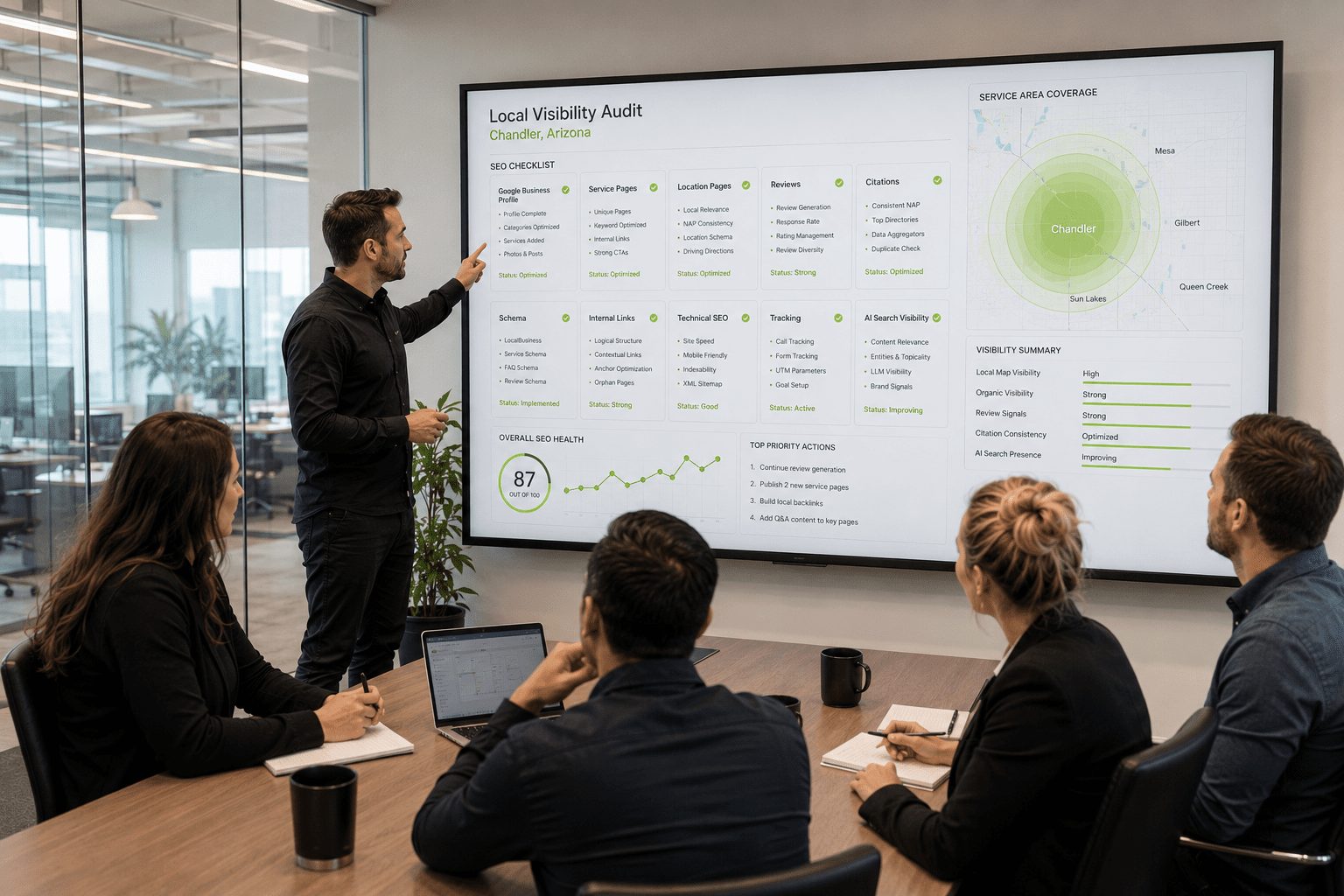
Most SEO checklists are too generic. They tell you to add keywords, write title tags, build backlinks, and publish content. Those items may have a place, but they do not give most local business owners a practical view of what actually affects visibility in a market like Chandler.
A Chandler business needs a checklist built around local discovery. Customers may find you through Google Search, Google Maps, your Google Business Profile, reviews, directories, navigation apps, AI search tools, local service pages, or referrals that lead to a branded search. Your checklist should help you strengthen the signals across those places.
The goal is not to complete tasks for the sake of activity. The goal is to make your business easier for Google and AI to understand and easier for customers to trust when they are ready to call, book, request a quote, or compare options.
Use this checklist to audit whether your local visibility foundation is clear, consistent, and connected.
1. Check Your Core Business Information
Start with the basics. Your business information should be accurate everywhere customers and search systems find you. This includes your website, Google Business Profile, directory listings, social profiles, and industry platforms.
Check your business name, address, phone number, website, hours, categories, service areas, and contact options. If these details are inconsistent, your local signals become weaker and customers may lose trust.
- Business name is accurate and consistent.
- Address is correct if you have a physical location.
- Phone number is current and answered professionally.
- Website URL is correct.
- Hours and holiday hours are current.
- Service areas reflect where you actually work.
- Contact forms, buttons, and scheduling links work properly.
2. Audit Your Google Business Profile
Your Google Business Profile is one of the most important local visibility assets. For many Chandler businesses, it is the first impression customers see in Google Search and Google Maps.
Your profile should be complete, accurate, and aligned with your website. The primary category should describe the main business. Secondary categories should support real services. Photos should be current. Services should be filled out. Reviews should be monitored and answered.
Review the profile as if you were a customer comparing options. Does the business look active? Is it clear what services are available? Are the photos real? Are reviews recent? Is the website link useful?
3. Review Your Website Architecture
Website architecture determines how your services, locations, resources, and calls to action are organized. A weak structure makes it harder for customers and search engines to understand what matters.
A local business website should not rely on one broad services page if multiple services drive revenue. Each major service should have enough space to explain the problem, solution, process, trust factors, and next step.
Your site should also make navigation simple. Visitors should quickly understand what you do, where you work, why they should trust you, and how to contact you.
- Homepage clearly explains the business and market.
- Core service pages are easy to find.
- Location or service-area pages are useful and not duplicated.
- FAQs answer real buyer questions.
- Internal links connect related services and resources.
- Calls to action are visible and easy to use.
4. Check Your Service Pages
Service pages are one of the most important checklist items for local businesses. If you want to be found for a specific service, your website should explain that service clearly.
A strong service page should not be a thin paragraph with a phone number. It should describe what the service includes, when someone needs it, what problems it solves, what your process looks like, what related services matter, and how a customer can take action.
For Chandler businesses, service pages should also support local relevance naturally. That does not mean stuffing the city name everywhere. It means making it clear that the business serves local customers and understands the market.
5. Check Location And Market Coverage
Many Chandler businesses serve nearby markets such as Gilbert, Mesa, Tempe, Phoenix, Scottsdale, Sun Lakes, or broader East Valley areas. If that is true for your business, your website should clarify market coverage in a useful way.
Avoid creating dozens of low-quality city pages that say the same thing with only the city name changed. Instead, create location or service-area pages when they help customers understand availability, services, local context, and next steps.
A good market coverage page should feel useful to a real customer, not like a search engine doorway page.
6. Audit Reviews And Reputation Signals
Reviews help customers decide whether to trust your business. They also support the broader picture of prominence and credibility. Your checklist should include review count, average rating, review recency, review content, and owner responses.
A strong review process is simple and ethical. Ask real customers for honest feedback after a successful experience. Make the process easy. Respond professionally. Do not buy reviews, fake reviews, or pressure customers into unnatural wording.
Look for patterns in your reviews. Do customers mention the services you want to grow? Do they mention responsiveness, professionalism, quality, timing, or specific team members? Do your responses show that the business is active and accountable?
7. Clean Up Citations And Directory Listings
Citations are mentions of your business information across directories, local platforms, navigation apps, data providers, and industry sites. They often include your name, address, phone number, website, categories, and hours.
Citation consistency matters because inconsistent data creates confusion. Old phone numbers, outdated addresses, duplicate listings, wrong categories, and missing website links can weaken local business signals.
Focus on the directories and platforms that matter most. Accuracy is more important than volume. If your business has moved, rebranded, changed numbers, added locations, or expanded service areas, citation cleanup should be a priority.
8. Check On-Page SEO Basics
On-page SEO helps each page communicate clearly. Review the title tag, meta description, headings, body copy, internal links, images, image alt text, FAQs, and calls to action.
Each page should have one clear purpose. A service page should explain the service. A location page should explain market coverage. A blog post should answer the question that brought the reader there. If a page tries to do too many things, it often does none of them well.
- Each page has a clear title and main heading.
- Important keywords are used naturally.
- Headings make the page easy to scan.
- Images have useful alt text.
- Internal links guide users to logical next steps.
- Calls to action are clear and relevant.
9. Review Technical SEO
Technical SEO supports crawlability, usability, and performance. It should not be ignored, but it should also be kept practical. The goal is to make the site fast, mobile-friendly, secure, and easy for search engines to access.
Check for mobile usability, page speed, HTTPS, indexation problems, broken links, redirect issues, XML sitemap access, robots.txt problems, duplicate pages, and oversized images. Local customers often search on phones, so mobile experience matters.
Technical problems can prevent good content from performing. Fix the issues that affect users, crawling, and conversion first.
10. Add Schema Markup Where It Helps
Schema markup helps search engines understand the meaning of your content. It does not replace useful pages, but it can reinforce important business and page details.
Local businesses may benefit from LocalBusiness schema, Service schema, FAQ schema, BlogPosting schema, and Breadcrumb schema. The schema should match the visible content on the page. It should not include unsupported claims.
Schema is most helpful when your site already has clear service pages, location information, FAQs, and business details.
11. Improve Internal Linking
Internal links help users and search engines understand how your pages connect. A service page should link to related services, helpful FAQs, and relevant location pages. A blog post should point readers to a deeper resource or logical next step.
Good internal linking makes your website more useful. It also helps prevent important pages from becoming isolated.
Review whether your core service pages are linked from the homepage, navigation, related articles, and relevant location pages. If an important page is hard to find, it is less likely to perform.
12. Check Tracking And Conversion Paths
SEO should be measured by business outcomes, not just rankings. Your checklist should include calls, forms, scheduling clicks, direction requests, Google Business Profile actions, page-level performance, and lead quality.
Use analytics, Google Business Profile performance data, UTM-tagged links, form tracking, and call tracking where appropriate. Look at which pages produce real opportunities and which channels create qualified conversations.
If you cannot see what is working, you cannot prioritize the right improvements.
13. Check AI Search Visibility
AI search visibility is becoming part of the local discovery process. Customers may use AI tools to compare businesses, ask for recommendations, summarize options, or understand who provides a specific service nearby.
Your business is easier for AI systems to understand when your website, Google Business Profile, citations, schema, reviews, service pages, and market coverage are clear and consistent.
This does not mean writing content for robots. It means making the business easy to interpret across the web.
How Atlas™ Turns The Checklist Into A System
Firm IQ uses Atlas™ as a visibility foundation for local businesses. Atlas includes the work needed to help Google, Google Maps, AI search tools, directories, navigation platforms, and customers better understand a business.
That can include website service pages, location pages, market pages, Google Business Profile signals, reviews, citations, directory listings, local business schema, service schema, internal links, tracking, AI visibility briefs, business signals, and market coverage.
The checklist matters because it shows where the system is strong and where it is weak. The best local visibility work usually starts by identifying the gaps that competitors showing up ahead of you have already addressed.
The Bottom Line
A strong SEO checklist for Chandler, AZ businesses should include business information, Google Business Profile optimization, website architecture, service pages, market coverage, reviews, citations, on-page SEO, technical SEO, schema, internal links, tracking, and AI search visibility.
The checklist is not about doing more random marketing tasks. It is about building the signals that help Google and AI understand your business and help customers choose you with confidence.
Great businesses do not always get found. The businesses that Google and AI understand most clearly are often the businesses that get recommended.
Want a clearer view of what your business is missing? Request an Atlas Gap Analysis. Firm IQ compares how your business is currently being found against competitors showing up ahead of you, then identifies visibility gaps, market coverage opportunities, and recommendation signals Google and AI may be missing.
FAQ: SEO Checklist For Chandler, AZ Businesses
What should be included in an SEO checklist for a Chandler business?
An SEO checklist for a Chandler business should include Google Business Profile optimization, service pages, website architecture, reviews, citations, schema, internal links, technical SEO, market coverage, tracking, and AI search visibility.
How often should a local business run an SEO checklist?
A local business should review major SEO checklist items at least quarterly. Google Business Profile details, reviews, tracking, and business information should be checked more often when services, hours, locations, or market focus changes.
What is the most important local SEO checklist item?
There is no single item that does all the work, but Google Business Profile accuracy, strong service pages, reviews, citations, and tracking are usually among the highest-impact items for local businesses.
Should an SEO checklist include AI search visibility?
Yes. AI search visibility should be included because customers increasingly use AI tools to compare and understand local businesses. Clear service pages, consistent business data, reviews, schema, and citations help AI systems interpret the business.
Can Firm IQ audit my SEO checklist?
Yes. Firm IQ’s Atlas Gap Analysis compares your business against competitors showing up ahead of you and identifies gaps across your website, Google Business Profile, reviews, citations, schema, internal links, market coverage, tracking, and AI visibility signals.